




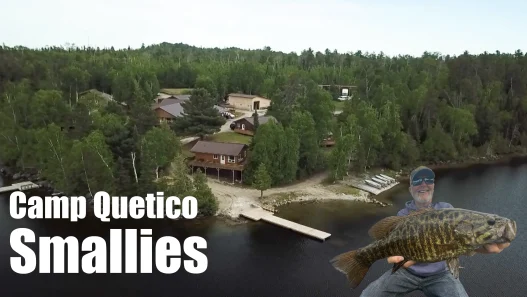





Al Lindner and Gary McEnelly visit the legendary Quetico region and load up on trophy smallmouth in remote Canadian waters.
There are places in this world that just feel right the moment you arrive.
For me, Sunset Country in Ontario—especially the Atikokan area around Camp Quetico—is one of those places. I’ve been coming up here for close to 50 years now, and I can tell you this: it never gets old. The water, the fish, the wilderness… and most importantly, the lessons these fish teach you every single day.
And on this trip, the smallmouth bass reminded us of something I’ve said for decades:
Always be ready. Let the fish tell you what to do.
The Setup: A Trip Full of “What Ifs”
We loaded up with one goal in mind—big smallmouth bass.
The plan sounded simple: five days of good weather, classic Canadian conditions, and a steady bite. But when you’re dealing with weather—especially up north—that’s always a big “if.”
We made the long drive, crossed over Rainy Lake, and settled into one of the most beautiful fisheries in the world. The kind of place where every rock pile, reef, and windswept point looks like it should hold a fish.
And most of the time… it does.
Day One: Topwater Paradise
Hot. Muggy. Flat calm.
That’s a recipe for one thing in Canada:
Topwater smallmouth.
And those fish were chewing the paint off our baits.
We worked classic structures—rock reefs, shallow points, edges—and they were coming up violently. Big brown bass exploding on poppers, prop baits, and walking baits.
If you’re heading up here, there are four topwater styles you absolutely need:
- Popper (my #1 producer)
- Prop bait
- Walking bait
- Tail bait
Each one has its place, but when it comes to numbers and consistency, the popper is tough to beat.
And here’s something a lot of anglers overlook:
Cadence matters.
Sometimes it’s not the bait—it’s how long you pause it. That hesitation can be the trigger that turns a follower into a strike.
Day Two: Everything Changes
Overnight, everything flipped.
Wind out of the northwest. Temperatures dropped. Conditions changed fast.
And just like that…
The topwater bite disappeared.
That’s smallmouth fishing.
The fish slid deeper. They moved onto windswept points and transition areas, and suddenly jerkbaits became the deal.
We started targeting:
- Rock points with wind blowing in
- Sand-to-rock transitions
- Current areas where water was moving through narrows
And just like that—we were back on big fish.
Jerkbait Time: Cover Water, Find Fish
When the wind hits structure, smallmouth set up in predictable positions.
That’s when I reach for a jerkbait.
We rotated through three key styles:
- Rapala X-Rap – shallow, aggressive fish
- Shadow Rap Deep – cold water finesse situations
- PXR Mavrik® 110 (especially deep) – a crossover that flat-out produces
On this trip, the Mavrik Deep was a standout. It got down, stayed in the zone, and triggered fish that wouldn’t even look at a topwater anymore.
And here’s the key:
Wind + rocks + points = jerkbait fish.
Structure Over Fish (Electronics Insight)
Everyone talks about forward-facing sonar these days.
And yes—it’s helpful.
But more often than not, I’m not using electronics just to see fish.
I’m using it to see structure.
- Boulders 30–50 feet away
- Subtle breaks on reefs
- Edges you can’t see with your eyes
When you can cast precisely to those targets, your efficiency goes way up—and so does your catch rate.
Understanding Canadian Smallmouth
Here’s something important:
Smallmouth are nomadic.
They move.
In rivers, they’ll travel miles. In these shield lakes, they roam reefs, suspend over deep water, or slide shallow depending on conditions.
They might be:
- Eating crawfish on the rocks
- Chasing ciscoes in open water
- Suspended over 40–50 feet
- Or cruising shallow flats
But they all have one thing in common:
They’re aggressive—and they’ll tell you what they want.
The “Edge” Most Anglers Miss
We always talk about edges:
- Weed edges
- Rock edges
But one of the biggest edges in the lake is this:
The surface.
In clear Canadian water, a smallmouth can see a topwater bait from 20–25 feet away—even if it’s sitting over deep water.
That’s why you can catch big fish over 40 feet of water on a topwater bait.
Never forget that.
Gear That Matters
When you’re in remote country, your gear has to work. Period.
Here’s what I relied on:
- Rod: 6’8” medium, extra-fast action (perfect for topwater control)
- Reel: High-speed (7.3:1) to maximize efficiency
- Line: 14 lb monofilament for topwater applications
That faster reel helps you burn back through dead water and make more effective casts throughout the day.
And over time, that means more fish.
Why Camp Quetico Stands Out
There’s something special about this region.
- Dozens of connected lakes
- Incredible diversity
- Big fish potential everywhere
As Barry at Camp Quetico told us, there are 40+ lakes with access and over 100 boats running.
Some lakes give you numbers. Others give you giants.
But everywhere you go…
There are smallmouth.
Final Lesson: Adapt or Get Left Behind
This trip was a perfect reminder:
- One day: topwater chaos
- Next day: jerkbait precision
Same lake. Same fish. Completely different behavior.
If you come up here locked into one technique, you’re going to struggle.
But if you stay flexible—If you watch the wind, the weather, and the fish…You’re going to have the trip of a lifetime.