




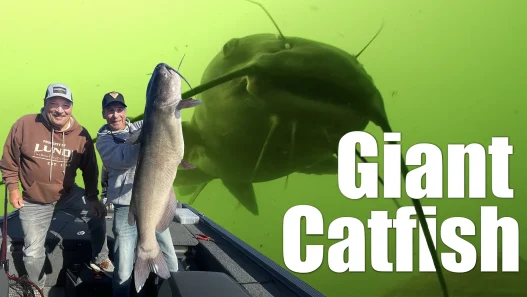






James Lindner and Jake Wallace are in Sunset Country, Ontario, targeting walleye and pike using jigs rigged with soft plastics.
A Camp Built on Past Events
Tucked in the far-off north wilderness is a fishing camp with rich historical background and even stronger passion of angling.
Constructed during the winter of 1986–1987, the camp is located on a site rich in Canadian history; Osnaburg House, the first inland trading post run by the Hudson’s Bay Company, originally called this site home.
Originally founded in 1786, the post stayed active until the late 1950s or early 1960s, when better access to Pickle Lake drove the trading activity to move along the highway.
Driven by a passion for restoring the land, the founders of the camp were enthralled by the rich history and breathtaking natural beauty of the area and realized it could be a top fishing destination.
A camp born with a goal anchored in both history and hospitality grew out of Lake St. Joseph’s provision of some of Ontario’s best freshwater fishing.
A Lake Unique from All Others
Lake St. Joseph first seems to be amazing in scale—stretching 90 miles long and up to 20 miles wide. Beyond its remarkable scale, though, this outstanding fishery is really defined by its varied architecture and rich fish habitat.
Although the lake has numerous deep pockets, its average depth is between 40 and 50 feet. From shallow edges to depths of 30 or 40 feet, vast flats offer an apparently limitless network of outstanding fishing grounds.
Not only from their local expertise but also from the navigational difficulties of the lake, guides are rather important here.
Common are long fingers, rock outcroppings, and unmarked hazards, hence skilled advice is not only for safety but also for enhancing the fishing experience.
Grand Fishing Days on Lake St. Joseph
The lake’s standing as world-class fishery is not hyperbole. Good days have fisherman reporting catching fish as quickly as they could drop a line. Guide Matt Strumpf introduces visitors about the convoluted design and rich waters of the lake.
Hauling in hundreds, if not hundreds of fish in one day is not unusual. One group, visiting yearly for more than ten years, noted shockingly high 10,000 walleyes over ten years, with little thought given to the similarly plentiful northern pike.
The lake leaves’ sheer abundance really makes a difference. “Every place you visit has fish on,” one angler said. The action is continuous and exciting whether fishing broad flats, remote coves, or rock-lined creeks.
Lake St. Joseph is a place to land actual giants in addition to a numbers game. One trip, an angler hauled in an amazing 41-inch northern pike. The fish, hooked cleanly and handled carefully, were evidence of the quality of the fishing.
Lake St. Joseph is among the top drive-to locations for large pike among seasoned fishermen who have fished far and wide. And the lake repeatedly confirms their correctness. From big pike to several monster walleyes, this fishery surpasses expectations and generates stories.
A wilderness experience for every generation.
The fact that this location is easily reachable for anglers from various backgrounds and ages adds to its uniqueness. Year after year families come back to create customs and strengthen their bond with the ground and water.
One visitor, a frequent visitor since the late 1990s, detailed how three generations of his family had just made the journey to Lake St. Joseph. For them, it is a treasured tradition rather than just a fishing trip.
The lake’s special classification as a wilderness fishery limits yearly attendance to about 1,700 persons. For those who are fortunate enough to visit, this guarantees a more personal, unspoiled experience in addition to maintaining the quality of the fisheries.
More Than Just Hunting
Beyond casting lines, visitors enjoy the whole northern experience, including rustic, filling meals created with fresh ingredients and a little bit of history.
For a basic, filling meal, one lakeside feast featured perfectly sautéed mushrooms and onions put atop walleye fillets then seasoned with the camp’s own “Old Post” fish seasoning.
The sense of community of the camp is as strong as that of the fishing. On the boat, on the pier, and around the fire, friendships grow. Lake St. Joseph provides something quite unique: a link to nature, history, and each other whether your goal is trophy pike or simply enjoying a flawless cast beneath an unending sky.
Versatility in Tackle: Examining the Walleye Set Closely
The action continues as another northern pike caught, quite remarkably, on a walleye setup and put back into Lake St. Joseph’s waters. This tells a great deal about the adaptability of the rod and reel combo being applied. This St. Croix Avid Series 7-foot medium power, fast action rod configuration turns out to be a real workhorse for several presentations. This rod handles all, even dragging live bait or swimming plastics, with a sensitive tip and a backbone able to musle larger fish like northern pike.
This arrangement produces smooth drag performance when combined with the new Daiwa Fuego 2500 spinning reel, therefore enabling even heavy predators to be controlled.
Ten-pound Sufix 832 neon paired with an 8-foot Sufix fluorocarbon leader (of 10-pound test) tied with a FG knot fills the spool. Near the terminal end? The VMC Tungsten Jig wore a devastating mix for the multi-species action Lake St. Joseph offers—a Big Bite Bait Suicide Shad.
Regulations-Ready: Barbless Single Hook
Lake St. Joseph has a single hook, barbless control, hence lure choice becomes even more important. Under these limitations, the Big Bite Bait Suicide Shad succeeds providing a profile and movement that nevertheless produces consistent bites without sacrificing legal compliance. Fish have been caught by the team at a variety of depths, from shallow 4–6 feet to deep 25–30-foot ranges.
Jig Trolling for Fish in Mid to Deep-Water
Especially for covering water and aiming at suspended fish, jig trolling—a quite basic but nevertheless successful tactic—has proven one particularly beneficial method. Using a 3/8-ounce jig with a soft plastic, the strategy is to troll at a consistent 0.5 to 0.8 mph and maintain the bait hung 2 to 3 feet above the bottom. This elongates the lure in the strike zone and reduces snags. Success frequently comes fast, as the video shows—sometimes within seconds of jig back falling.
Negotiating the Unmapped: Following and Scanning
One of the particular difficulties fishing distant northern lakes like Lake St. Joseph is insufficient or faulty lake maps. The club uses two clever navigation techniques to get beyond this: Day one they dropped waypoints on every productive region, followed a lead boat, and preserved the whole chart.
This offered them a consistent and safe travel path. 2 High-speed Scanning: They scan using 2D sonar to identify bottom composition changes, rock piles, and humps—areas that commonly retain fish—while moving between 15 and 25 mph. On the sonar screen, hard-bottom transitions show as a change from soft green to hard red, providing hints for potentially interesting new areas.
intelligent
Lure Selection for Pike
When it comes northern pike, it’s not about having hundreds of lures—just the correct handful for the conditions. Excellent producers have been spoons and inline spinners. While some others have had success with both inline spinners and safety-pin style spinnerbaits, Jake has been depending on the Blue Fox spoon.
- Inline spinners and spoons efficiently cover water in shallow vegetation and rock flats.
- Large swimbaits or fluke-style plastics (6–8 inches) fished with heavier jigs have performed primarily for deeper edges.
- Big safety-pin spinnerbaits are the weapon in thick weed beds, particularly when aiming for fish submerged in 8–12 feet of heavy cover. Fish are drawn up and out by their sluggish retrieve and powerful vibration.
Managing Water Effectively
The sheer enormity of the fishable areas is one reoccurring motif. Because weed beds might span a mile or more, applying baits with quick water coverage is imperative.
Jimmy throws an inline spinner, and Jake uses a spoon; they scan large flats looking for active fish. This approach finds hot zones rapidly, at which point they can slow down and adjust their presentation.
On these large apartments, species may cross—walleye and pike sharing the same territory. As observed in real-time on the trip, casting for pike and then abruptly sticking a prize walleye is not unusual.
Value of Boat Control and Vision on the Water
A crucial lesson about the need of boat control comes to light as the journey comes to end. Although many fishermen concentrate on gear, lures, and electronics, the art of navigating the boat to stay in the striking zone, maintain appropriate bait depth, and change for wind or current is just as important.
One of the crew members underlines that accurate boat location and control are usually the key factors behind good catches, particularly in cases of several kinds of baits including spoons, jigs, spinners, and swimbaits.
Whether your goal is jig-trolling for suspended walleye, working the edge of a weed flat for pike, or searching open water for structure, accurate boat positioning guarantees that your lure is delivered consistently and correctly. Though it’s a talent sometimes underappreciated, as this episode shows quite plainly, it’s absolutely essential to maximize any venue.
Seeing Clearly: Visual Edge on the Water
Vision is really important as well. “You want to be able to see in the water,” the narrator says as he notes Good vision improves decision-making in everything from identifying structure under the surface to monitoring baitfish to just interpreting changes in water clarity and weed growth. By eliminating glare and exposing underwater minutiae others would overlook, high-quality polarized eyewear—like those from Wavy Label Eyewear—which is recognized as a show partner—can give fishermen a real edge.
From negotiating uncharted seas and honing several fishing presentations to honoring local rules and appreciating the delight of a simple, fish-based dinner, this adventure has it all. From jigging deep water walleye to smashing large pike on classic spoons, the variety of techniques and species—combined with amazing distant landscapes—make this a place worth visiting.

