









Mastering the Late-Season Fish Migration
It was a brisk 33 degrees when the day began—perfect weather for chasing fall river smallmouth, one of the most exciting fall patterns in freshwater fishing. With a third cup of coffee and a call to his fishing partner James, the plan was set: head to the river and target smallmouth bass during one of their most predictable transitions of the year.
As the temperature slowly climbed into the mid-40s and the wind began to pick up, the decision to fish the river over a lake proved wise. This time of year, fall river smallmouths begin a significant and consistent movement—an annual migration that savvy anglers across the country can reliably count on.
Fall River Smallmouths Seasonal Movements and Overwintering Zones
Rivers host dynamic ecosystems, and their fish populations respond with equally dynamic behavior. As water temperatures dip into the low 50s, smallmouth bass start shifting from summer haunts on shallow flats—sometimes 50 to 60 miles upriver—toward wintering holes near dams.
These fish generally concentrate in two primary areas: just above or just below a dam. These are slower, deeper pockets of water with reduced current—ideal for overwintering. This same behavior is echoed by other river species like walleyes and catfish, which gather in deep holes or slack water zones for the cold months ahead.
This mass movement creates a seasonal bottleneck of fish, concentrating them into very specific areas. And that’s exactly where today’s action was unfolding.
Early Action: Big Smallies Close to the Boat
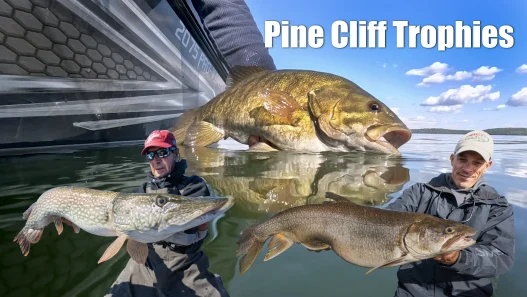
Right on cue, the first big smallmouth appeared—a thick, aggressive fish that followed and crushed a bait just feet from the boat. The energy and power of these late-season smallies were immediately on display.
“These fish are tanks,” Al noted as another giant smallmouth thrashed its way to the net. These aren’t just average fish. Many of them have traveled dozens of miles downstream to this exact location, drawn by the instinctive pull to overwintering territory.
Fall River Smallmouths Location, Timing, and Key Presentations
The interesting thing about this specific stretch of river is that it’s only a seasonal hot spot. While a small resident population remains year-round, the fall influx brings in much larger, heavier fish. Anglers fishing here in summer might overlook the area entirely, not realizing that it’s a fall goldmine.
A key bait for the day was the Rapala Maverick, a jerkbait designed for cold-water conditions. With the ability to suspend in place and deliver erratic, triggering action, it shines when fish are sluggish or tentative. The Maverick joins a full deck of tools including spinnerbaits, swim jigs, shallow-running cranks, and Ned rigs—each one valuable depending on how the fish are behaving on any given day.
But for colder days like this, nothing beats the pause-and-twitch cadence of a suspending jerkbait. It’s a proven trigger for big river smallmouths.
Rivers vs. Lakes: Why Flowing Water Wins in Fall
One reason fall river fishing can be so productive is because it circumvents the disruption of lake turnover. At the time of this trip, most area lakes were sitting around 59 to 61 degrees and in full turnover mode—a process that often slows down the bite and scatters fish.
Rivers, with their consistent oxygenation and flow, remain more stable, making them a refuge for both fish and anglers looking to avoid turnover blues. Whether it’s bass, walleyes, or muskies, flowing water in fall is always worth a closer look.
Bonus Fish and Stellar Gear
While targeting smallmouths with jerkbaits, the anglers also enjoyed a surprise catch—a big golden walleye that crushed the bait near the boat. It’s not uncommon for walleyes to show up as “bonus fish” this time of year, especially in river systems where species overlap and feed opportunistically.
The day’s gear included high-end setups for maximum sensitivity and performance. Jim and Al both used St. Croix Legend X rods paired with Daiwa Steeze reels and spooled with Sufix 14-pound fluorocarbon. Fluorocarbon’s density and sink rate make it ideal for jerkbait presentations, allowing for better control, more natural suspensions, and ultimately more bites.
Understanding Current and Casting Strategy
Even in wide sections of the river where it begins to feed into a reservoir, current remains a critical factor. Specific current seams and push zones still attract fish in concentrated numbers. That’s where they focused their efforts—looking for subtle changes in flow and structure that hold big fall smallies.
And once again, the reward came in the form of another giant smallmouth—net-worthy and photo-worthy.
Fine-Tuning Fall Success: Timing, Location, and Presentation
As the river continued to give up its fall treasures, the pattern became undeniable. Nearly every smallmouth that hit the net was a chunk—thick-bodied, healthy, and eerily similar in size. When you crack the code on a fall bite like this, and everything aligns—water temperature, bait selection, current direction—you’re not just fishing, you’re stacking trophies.
The key takeaway? Timing is everything. Once you understand the conditions that trigger fall migrations and how fish relate to current, you can return to these patterns year after year and find success. As Jim put it, “One after the other, after the other.”
River Location Strategy: Specifics That Make a Difference
Even in larger river systems that merge into reservoirs, fall smallmouth bass still relate tightly to current. Identifying the right locations involves understanding both macro and micro habitat features. Key fall holding zones include:
- Main river channel points and flats
- Channel swings that concentrate current
- Sunken islands adjacent to the main flow
In early fall (with water temps in the 50s), smallmouths hold on shallow flats in 4–8 feet of water. As it cools into the 40s, they gradually slide deeper—often 10 to 20 feet—seeking stable conditions as winter approaches.
The Importance of Casting Angle in Current
An often-overlooked but critical detail in river fishing is casting angle. Because river fish almost always face upstream, it’s essential to quarter your casts across and slightly upstream, allowing the bait to drift or swim into their strike zone. Whether you’re throwing jerkbaits, crankbaits, spinnerbaits, or swimbaits, this approach increases the odds of getting bit.
Using Forward-Facing Sonar to Refine Casts
Modern technology, especially forward-facing sonar, offers a powerful edge beyond simply spotting fish. Al and Jim used it not just to target individual fish, but to analyze cover transitions like weed edges, rock lines, and ledges. Being able to visualize and cast precisely to those zones—sometimes 60 feet out—dramatically increases efficiency and bite quality.
And when your screen shows a shadowy mark holding tight to the base of a drop-off, you know you’re in the right neighborhood.
Big Brownies and Bonus Fish
The day kept producing. Another monster smallmouth, pushing six pounds, bent the rod and demanded the net. “That’s what you call a real tank,” Al said, barely able to contain the excitement. With every giant that came to the boat, it was clear this was one of those magical fall windows—when the biggest fish of the year are feeding aggressively ahead of winter.
Even bonus fish showed up, including a heavy, golden walleye that inhaled a jerkbait. No surprise: late fall jerkbaiting in rivers can turn up just about anything.
The Power of Predictable Patterns
October might just be the best month of the year for multispecies fishing. Whether it’s smallmouth, largemouth, walleyes, muskies, or crappies, the largest individuals of every species are feeding hard ahead of the freeze. Al summed it up well:
“The principle of understanding predictable seasonal movements skyrockets your odds of catching big fish on a consistent basis.”
That’s not just true for smallmouth. It applies to every species in every body of water.

