




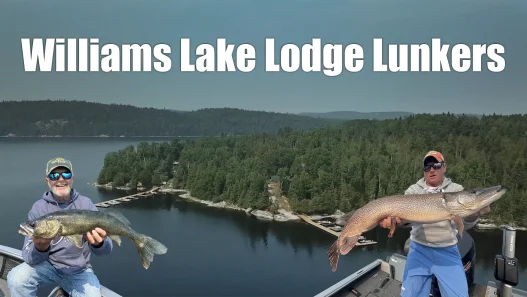






Everyone hopes to catch a large number of big fish on their trips. James Lindner and Jason Aleshire experience just that in Sunset Country, where they get into huge lake trout and smallmouth bass.
There are places in Northwest Ontario that fish well… and then there are places that grow giants.
On this adventure, we traveled to Big Sandy Lake in Sunset Country to experience trophy fishing at Pine Cliff Lodge—and from the first lake trout that slid into the net, we knew this lake was something special.
Our first fish of the day taped out at 33 inches. Thick shoulders. Deep girth. A true Pine Cliff special. And the remarkable part? That fish wasn’t an anomaly. It was a preview.
A Unique Fishery in Sunset Country
Big Sandy Lake is roughly 10,000 acres of deep, cold, clear water about an hour north of Dryden in Northwest Ontario. What makes it so intriguing isn’t just its size—it’s its structure and forage base.
This is classic Canadian Shield country. Rock reefs. Sharp breaks. Main-lake humps. Sand transitions. Deep basins. And swimming throughout that water column is a heavy population of rainbow smelt, along with whitefish and tullibees. When a lake has that kind of forage, predators grow thick—and they grow old.
Lake trout here commonly push into the 15- to 25-pound class. Smallmouth bass are wide-backed and heavy. Northern pike carry serious length and girth. Walleyes are healthy and aggressive.
It’s not a numbers lake in the traditional sense. It’s a quality lake.
And that’s the difference.
Trophy Lake Trout in Late Summer
We were fishing in late August—a prime window for big lake trout. After a cold front, much of the forage compresses into deep water. The trout follow.
In 60 to 65 feet of water, we used electronics to identify fish suspended 45 to 50 feet down. With line counter reels, we adjusted our presentation precisely to that depth. Drop to bottom. Reel up 15 to 20 feet. Engage the trolling motor. Watch the screen.
When they hit, they get your attention.
We ran a simple three-way rig:
- Baitcasting rod
- Line counter reel
- 4-ounce drop weight
- Lightweight flutter spoon
- Trolling at about 1 mph
The sinker ticked bottom while the spoon ran a few feet up—right in their face. It’s a clean, efficient system for covering water and triggering deep fish.
We also leaned heavily on vertical presentations:
- Ripping blades
- Bucktail hair jigs
- Hybrid swimbait heads with minnow-style plastics
- Heavy spoons for aggressive fish on structure
One of the highlights came on a main-lake reef known locally as Pigeon Hump. Marked fish. Dropped a spoon. Fish came up and absolutely lunched it. Another 33-inch lake trout.
When you catch multiple trout of that caliber in a single day, you begin to understand the potential of a fishery.
Multi-Species Structure Fishing
What impressed me most about Big Sandy is how multiple species share the same structural elements.
Rock-to-sand transitions. Secondary rock piles. Main-lake humps topping out shallow and tapering into 20–25 feet. In late summer, everything sets up there.
We shook minnows—particularly paddletail and jerk-minnow style baits—along those breaks. That technique has become dominant across North America, and for good reason. It mimics smelt perfectly.
On a single structure we encountered:
- Smallmouth bass
- Walleyes
- Northern pike
- Even lake trout in adjacent depth zones
The smallmouth were classic late-summer footballs. Heavy. Thick. Feeding hard before fall. The walleyes slid in and out of the same transition zones. And the pike? They were stationed wherever forage had to funnel past cover.
That’s ecosystem efficiency at work.
The Pine Cliff Experience
What makes Pine Cliff Lodge so unique is the balance between accessibility and exclusivity.
It offers a fly-in caliber fishery with drive-to convenience. It’s the only public access on Big Sandy Lake, with just a few private cabins scattered around the shoreline.
The lodge operates as a housekeeping-only experience with six fully equipped cabins. Everything you need is there—full kitchens, grills, fish fry equipment. You bring your towels and your groceries. The rest is dialed in.
The boat fleet is equally impressive:
- 50-horse four-stroke motors
- Center consoles
- Modern electronics
- Trolling motors with spot lock
Serious anglers appreciate that kind of equipment because it allows you to fish efficiently and precisely.
And when you’re targeting trophy-class fish, precision matters.
A True Trophy Destination
We saw lake trout over 30 inches. Thick northern pike. Wide-bodied smallmouth. Quality walleyes. And guest stories of returning year after year reinforced the consistency of the experience.
This is not a place you visit once and forget.
It’s a place you circle on the calendar.
When you talk about trophy fishing close to home—without the logistics of fly-in travel—Pine Cliff Lodge on Big Sandy Lake stands out in spades.
Big water. Big structure. Big forage. Big fish.
And for anglers who appreciate quality over sheer numbers, that’s exactly what makes it special.
We’ll be back.

