




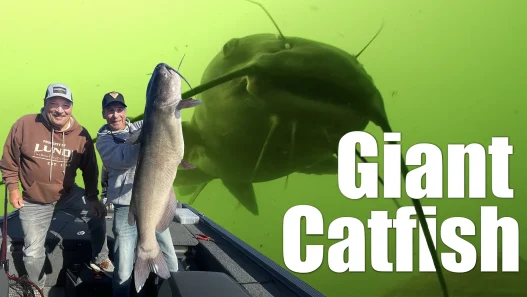






James Lindner and Alex Keszler tangle with giant channel catfish on the Red River, proving why this place holds the title of the world’s top channel cat fishery.
There are certain fisheries across North America that anglers whisper about—places where big fish aren’t just possible, they’re common. The Red River below Lockport Dam is one of those rare destinations.
This stretch of river, flowing into massive Lake Winnipeg, has earned global recognition for producing enormous channel catfish in staggering numbers. Spend a few hours here with the right setup and the right understanding of how these fish use current, and it becomes clear very quickly why anglers travel hundreds—sometimes thousands—of miles to experience it.
This is big-river catfishing at its finest.
A Fertile System Built for Giant Fish
The Red River and Lake Winnipeg watershed is one of the most fertile freshwater ecosystems in North America. The system supports massive populations of baitfish and rough fish—particularly goldeyes, which are a key food source for the catfish that roam this river.
With that much forage available, channel cats grow large and grow fast. Fish in the 12- to 25-pound class are extremely common, and every season produces true giants pushing far beyond that mark.
But what really separates this fishery from many others is density. The sheer number of catfish in this river system is extraordinary. Anglers can literally catch hundreds of pounds of fish in a single outing.
In fact, many anglers who come here for the first time leave with the same reaction: I’ve never experienced fishing like this.
Catfish Are Not Bottom-Dwelling Slugs
One of the biggest misconceptions in fishing is that catfish are lazy bottom feeders.
In reality, channel cats in a large river system behave much more like apex predators.
They move through current seams.
They chase baitfish.
They travel long distances throughout the system.
These fish are constantly on the move, often migrating from Lake Winnipeg up the Red River in pursuit of food sources. Once they locate bait concentrations, they settle into strategic feeding lanes where the current delivers prey directly to them.
And when they strike, it’s anything but subtle.
In heavy current, a catfish bite often feels like someone grabbed the rod and started running downstream with it.
Understanding Current: The Key to Catfish Positioning
If there’s one element that dictates everything about Red River catfish fishing, it’s current.
From the surface, many dam areas look like uniform water pouring downstream. But below the surface, current is incredibly complex.
Dams, bridge pillars, and bottom structure create:
- Current seams
- Back eddies
- Deep scour holes
- Subtle ridges and shelves
These variations create ambush lanes where catfish hold and wait for food to drift by.
One classic scenario is a deep hole rising onto a shallow ridge. Catfish will often sit in the hole, waiting for baitfish or drifting food to wash over the rise.
When you position a bait on the upstream side of that structure, you’re effectively placing it right in the catfish’s feeding lane.
Make the same cast repeatedly and you may hook multiple fish from that exact spot.
The Classic Red River Catfish Rig
Despite the trophy fish and big water, the actual rigging system for Red River catfish is refreshingly simple.
The classic setup includes:
- Heavy main line (20–30 lb test)
- Barrel swivel
- Bead
- Short leader
- Octopus hook
- No-roll sinker
The bead serves an important purpose—it protects the knot from damage caused by the heavy sinker constantly tapping against it in the current.
No-Roll Sinkers
Sinker choice is critical.
A no-roll sinker is designed specifically for river fishing. Its flat shape keeps the bait anchored in place rather than tumbling downstream.
Anglers typically carry multiple sizes:
- 1½ ounce
- 2 ounce
- 3 ounce
- 4 ounce
- 5 ounce
The goal is simple:
Use just enough weight to hold the bait in place.
Too light and the bait drifts uncontrollably.
Too heavy and the presentation becomes unnatural.
Fresh Cut Bait: The Foundation of Success
Few presentations outperform fresh cut bait on the Red River.
Sucker chunks are one of the most reliable options, particularly the head section, which stays on the hook well and releases strong scent into the current.
Other effective baits include:
- Raw shrimp
- Frogs during warm periods
- Various cut bait species
The key factor is freshness. Fresh bait releases oils and scent that disperse quickly through the current, drawing catfish from surprising distances.
Catfish rely heavily on scent and vibration, making this one of the most powerful attractants in the river.
Holding Position in Heavy Current
Maintaining precise boat position is critical when targeting specific current seams.
Traditionally, anglers anchored upstream of a target area and fished downstream. But modern trolling motors with GPS anchoring have revolutionized the process.
With spot-lock systems, anglers can hold a boat in strong current with remarkable precision, allowing them to:
- Fish exact structure spots
- Reposition instantly
- Avoid constantly pulling heavy anchors
Holding position allows anglers to repeatedly present bait to the same productive lane—a major advantage when fish are stacked in specific areas.
Heavy Gear for Heavy Fish
These catfish are strong, especially in current.
Proper gear includes:
Rods:
Heavy-power catfish rods capable of handling large fish and strong river current.
Reels:
Low-gear-ratio reels provide extra cranking power when fighting fish moving with the current.
Line:
Monofilament in the 20–30 lb range is common. The stretch in mono helps absorb violent head shakes from large fish.
Many anglers prefer spinning gear because it allows them to brace the rod comfortably under their arm during the fight.
Float Drifting: Covering More Water
While bottom rigs dominate, another incredibly effective technique is float drifting.
This method uses:
- Slip float
- Stop knot
- Leader and hook
- Light sinker
The float is typically set 8 to 9 feet deep, allowing the bait to drift naturally through the current.
By opening the spool and feeding line, anglers can cover hundreds of feet of river with a single drift.
This technique shines when catfish are roaming or when searching for new productive areas.
Often, the float will suddenly dive below the surface—and the battle begins.
Expect Violent Strikes
Catfish strikes in current can be explosive.
Sometimes the fish grabs the bait and immediately runs downstream, meaning the angler must reel quickly just to catch up before setting the hook.
Other times the rod simply loads up under steady pressure as the fish moves away with the bait.
Either way, the fight that follows is powerful and unpredictable.
Large catfish twist, roll, and surge through the current, making them one of the most exciting freshwater fish to battle on rod and reel.
A World-Class Catfish Destination
Few fisheries offer the combination of:
- Trophy-size fish
- Incredible numbers
- Simple techniques
- Accessible water
That’s exactly why the Red River below Lockport has become one of the most famous catfish destinations in the world.
Spend a few hours there and you quickly understand why anglers return year after year.
The rods bend.
The drags sing.
And giant whiskered fish keep coming over the gunwale.
For anglers who love big fish and powerful battles, the Red River might just be the ultimate catfish experience.