








Cracking the Code on Dakota Reservoir Smallmouth
Early-season reservoir fishing bass tactics with Jeremy Smith & Al Lindner
The Immense Stage We Fish On
Reservoir Fishing man-made waters range from modest impoundments to watery giants. Consider Africa’s Lake Kariba: at 2,150 sq mi, it’s nearly twice the size of Rhode Island. In the United States, three of the ten biggest reservoirs—Lake Francis Case (≈100,000 acres), Lake Sakakawea (≈300,000 acres), and Lake Oahe (≈400,000 acres)—all sit in the North Dakota and South Dakota and form an angling corridor of legendary scale.
Our current playground is a “little brother” by comparison, but 5,000 fishable acres is hardly small. On this episode of The Edge, Jeremy Smith teams up with Al Lindner to unlock its spring secrets.
From Run-and-Gun to Finesse: Why the Weather Matters
Day 1 was classic power-fishing. Hard baits—especially the venerable Rapala X-Rap—let us burn down rocky points and identify active zones. The second morning, everything changed: a nor’easter dropped the air temperature 15 °F and soaked the shoreline. Rather than scatter, the smallmouth bass simply shifted mood.
Switching to jigs and soft plastics allowed us to:
- Pinpoint depth—confirming fish were hugging 8–12 ft edges.
- Adjust speed—slowing presentations to match post-frontal attitudes.
Smallmouth have a reputation for ignoring lousy weather, and today they proved it—biting steadily through cold rain and rising wind.
Understanding Flow: Where Different Species Stage in Spring
Reservoirs are essentially long, dammed rivers, so water always moves “downhill.” Early in the season:
- Walleyes & white bass instinctively push upriver, gathering in stronger current to spawn.
- Smallmouth, largemouth, pike & muskie act more like homebodies; once they claim a territory of rock, gravel, or weed, they rotate shallow-to-deep without long migrations.
Practical takeaway: when the main flow enters from the north, start your walleye or white-bass hunt toward the upper end, but expect smallmouth virtually anywhere the structure feels right.
Riprap: The Highway of Spring
Anglers often overlook riprap—man-placed “shot rock” protecting bridges, causeways, and shorelines—but it’s perpetual habitat. In the Dakotas, those rubble walls become a buffet line:
- Baitfish congregate for warmth, algae, and current breaks.
- Predators cycle through like commuters on a freeway.
Our strategy is simple: cover water fast with search lures, but the instant we contact fish, slow down and milk the stretch before hopping to the next bend or point. The pattern repeated all afternoon: cast, thump, rod bend—“pigs” as Al calls them—one after another.
Transition Depths: 8-to-12 Feet of Gold
Spring means flux. Some bass remain in deep wintering holes; others slide shallow when the sun peeks. The magic often lies between:
| Depth Zone | Why It’s Productive |
|---|---|
| 8–12 ft | Close enough to reach warming rocks yet deep enough for security during cold snaps. Wind pushes forage here, and bass follow. |
Every time we hovered over that band with a spot-locked boat, the rods loaded up.
One-Boat Network: Technology That Locks You On Fish
Modern electronics tie the whole boat together:
- Humminbird SOLIX units share waypoints, mapping cards, and 2-D/MEGA imaging.
- Minn Kota Ultrex with i-Pilot Link lets us anchor electronically, retrace tracks, or follow contours hands-free.
- Talons stand ready for shallow-water anchoring when precision is critical.
From helm to bow, everything “talks,” letting us spend less time positioning and more time catching.
Matching Line to Presentation
Hard-bait burners, finesse plastics, and jig swimmers each shine on dedicated line:
| Presentation | Recommended Main Line | Leader (if any) |
|---|---|---|
| Jigs / Tubes | 10–12 lb braid for sensitivity | 8–10 lb fluoro for invisibility |
| Swimbaits | 10 lb fluoro straight-through | — |
| Crankbaits / X-Rap | 10–12 lb mono for stretch | — |
Choosing the right diameter and material maximizes lure action and hook-up ratios—critical when every cast might connect with a Dakota trophy.
Fine-Tuning with Line Selection
When it comes to line choice, Jeremy Smith walks through a practical and proven strategy that gives him confidence across a range of presentations:
- High-Vis Braid: Sufix 832 in 10-lb high-vis yellow is a staple for both jerkbait and jig fishing. The visibility of the line is key for watching subtle bites, especially during a slackline fall.
- Nano Braid: For casting light baits like #5 Shad Raps, Sufix Nano Braid shines. It’s incredibly thin and casts light balsa baits long distances—even in wind. It’s rigged here on a glass spinning rod to match the action of the bait.
- Monofilament: Sufix Advance Mono (10-lb) is a go-to for rattlebaits. It offers just enough stretch to balance out the fast action of the bait and reduce the risk of ripping out hooks with heavy-wire trebles.
- Fluorocarbon Leaders: Tied in when needed for stealth or abrasion resistance.
Each rig is tailored for a purpose—and in the fast-paced world of spring smallmouth, being ready with multiple options is a major advantage.
A Tag-Team Approach on Every Spot
Al and Jeremy don’t just stick with the same lure—if one is throwing a boot tail swimbait, the other grabs a jerkbait or jigging bait. This one-two punch uncovers what the fish are responding to. Often, fish ignore one presentation only to smash the next.
They make a conscious effort to cover the same structure differently—and it pays off in quantity and quality.
Jerkbait Mayhem in the Wind
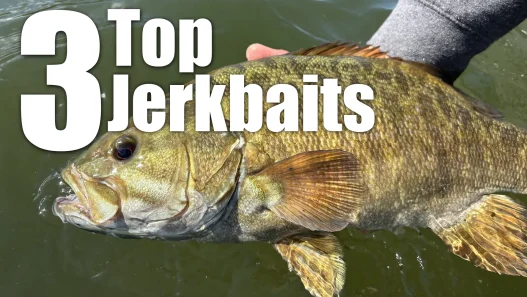
As the wind built during the day, the smallmouth bite shifted decisively in favor of the jerkbait. The fish began hammering the Rapala X-Rap—one of Jeremy’s favorites—and the team quickly adapted. Cast after cast produced another bronzeback.
“Man, I love spring smallmouths,” Jeremy exclaims. “Massive schools of fish. Just thick.”
The key pattern? Wind-swept points and rocky shorelines where current and chop created ideal ambush zones. The X-Rap’s erratic action in the wind sealed the deal time and again.
Wrapping the Trip: Smallmouth Gold
While the walleye and white bass didn’t show in big numbers this time, the smallmouth exceeded expectations. The team left feeling excited—and with plans to return.
“The smallmouth fishing is everything we heard about… and we’re coming back,” Al shares.
The trip confirmed a new gem on the radar for future episodes and deeper seasonal exploration. The name of the lake? That remains a mystery—at least for now.

