





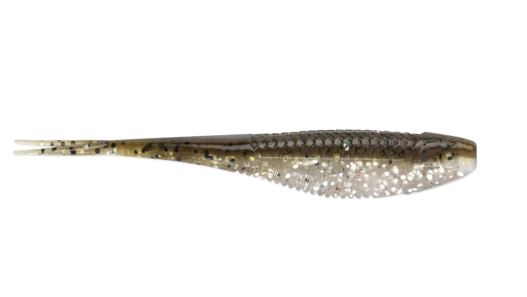




Use the right summertime crappie lures and there’s absolutely no need for livebait.
A Kaleidoscope of Lures—and the Challenge of Choice
Modern anglers face an almost overwhelming assortment of jigs, crankbaits, soft-plastic shapes, sizes, and colors.
Success starts by balancing three equal parts:
- Experience – past seasons’ wins and losses.
- Experimentation – trying fresh combinations until crappies vote with their mouths.
- Adjustment – fine-tuning on the fly as fish location or mood shifts.
On any given day the right blend of profile, action, and hue is the difference between a dry livewell and a quick limit.
Where the Calicos Roam: Deep Weed-Line Real Estate
In the natural northern lakes featured here, most summertime crappies abandon open water and settle into lush weed beds. Key observations from the boat:
- Outside bend of a major structure – a subtle turn in the weed line concentrates fish.
- Depth zone – weeds root at 16–17 ft in gin-clear water, forming a 4-ft-high canopy that tops out around 12 ft.
- Stretch length – roughly 100 yd of productive edge holds “hundreds and hundreds” of fish.
By swimming a lure just over the weed tops, the angler covers water efficiently while probing the whole column where crappies suspend, tuck under leaves, or slide out onto the sand.
Presentation Versatility: From Micro-Plastics to Mini Cranks
Two artificial styles dominate this pattern:
| Lure | Why It Shines | How to Work It |
|---|---|---|
| Tiny jigs with microplastics | Slim profile matches the thumb-length shiners crappies chase. Comes in endless shapes and rainbow-rivaling colors. | High: steady swim just under the surface. Low: pendulum through the stalks. Vertical: lift-fall when fish pin to bottom or canopy gaps. |
| Mini crankbaits | Compact enough for a crappie’s mouth yet hefty enough to cast far. Adds rattles and wobble to trigger reaction bites. | Vary retrieve speed to track anywhere from mid-depth to the crest of the weeds. |
When a tight cluster shows on electronics—or when the float rod dip-downs signal life—switching instantly between these baits keeps rods bending.
Weather Windows: Haze, Wind, and the Evening Surge
- Light overcast + ripple: Fish rise into the upper canopy even at midday, making them reachable without live bait.
- Calm, bright skies: Crappies slide deeper along the outer lip; slow rolls or longer casts score better.
- Dusk: Action turns “gangbusters” as fish pour out of cover, devouring anything that flashes overhead.
Understanding these shifts lets you stay on active pods rather than chasing ghosts.
Selective Harvest—Why Size & Slot Limits Matter
Crappies might be everyone’s favorite skillet fish, but they’re not inexhaustible. Minnesota’s Department of Natural Resources now imposes five-fish daily limits on select lakes to:
- Protect existing quality before new access or angling effort arrives.
- Restore former trophy waters where overharvest shrank average size.
- Distribute opportunity statewide so anglers aren’t forced into crowded hotspots.
Big panfish grow slowly; once a year-class is cropped down, recovery can take many seasons. Angler support, local input, and geographic balance are all baked into these regulations to safeguard the resource for the next summer evening fry.
Why Big Panfish Deserve Big Respect
A casual scan from the dock can fool anyone into thinking panfish are an endless resource. Yes, hordes of hand-sized bluegills and crappies swarm the shallows—but truly large specimens are rare and painfully slow to replace. Biologists note that:
- A Midwestern eight-inch bluegill often needs eight years to reach that length, roughly twice the maturation window of a trophy whitetail buck.
- Lakes face an either-or proposition: many small fish or fewer, larger fish. They simply cannot sustain both.
That hard math underpins today’s lake-specific slot and bag limits—sometimes just five fish per day—to balance harvest against the lake’s ability to grow the next crop of slabs. Angler cooperation keeps quality panfish fisheries alive for the long haul.
The Modern Artificial Arsenal—Leave the Minnow Bucket at Home
Decades ago a pail of fatheads felt mandatory. Not anymore. Between micro crankbaits and purpose-built plastics, you can fish “AI”—Artificial Intelligence—year-round and out-catch live bait.
Micro Crankbaits
Rapala’s downsized line now mirrors its premium bass lures:
- Neutral or slow-sink models to hover in a strike zone.
- Optional rattles for call-in power when visibility drops.
- Hyper-real paint schemes worthy of a display case.
Big bluegills in particular crash these bite-sized crankers with shocking aggression.
VMC’s Soft-Plastic Suite
| Jig Style | Trigger Mechanism | Best Situations |
|---|---|---|
| Wing Ding | Multiple tentacles pulse on micro shakes; broad “wings” slow the fall | Over sparse weeds where fish study a bait on the drop |
| Flap Tail | Beaver-style tail flaps like a leech or split for wounded-minnow wiggle | Swimming above cabbage tops |
| Nymph Jig | Insect profile matches early-season bug hatches | Cold-water docks or post-spawn shallows |
| Boot & Curly Tails | Classic thump or ribbon action | Anytime you need extra vibration in stained water |
All ride on VMC Power-Gap hooks for surer connections, and many versions glow after dark for dock-light sorties.
Electronics & Boat Control: Precision Without the Marker Buoy
Gone are the days of tossing a bright float to mark a school. Today’s workflow:
- Humminbird ONIX or SOLIX charts the cabbage edge in real time; AutoChart Live records every pass so the sweet spot never gets lost.
- Minn Kota i-Pilot Link talks to the sonar, locking the boat on a waypoint like an electronic anchor or tracing a chosen depth contour hands-free.
- A swing-head rugby jig (yes, the same one from the commercial break) sails long distances so you can keep the hull well off the fish and still reach the pocket.
Result: quiet, repeatable milk-runs along a 14- to 17-foot fringe where walleyes, pike, and bass push crappies up inside the 10-foot weed canopy.
Field Notes From the Weed Bed
- Overcast + ripple: fish roam higher in the cabbage, even at noon—no float required.
- Flat calm: slide deeper with a slow-sink micro crank or hover a plastic under a small fixed float.
- Evening haze: the “gangbusters” window—expect doubles and triples as crappies pour out to feed.
A mixed bag of 10 hand-picked fish—fillets for two—fits both modern regulations and the fry pan.
Beyond Rods & Reels: Reflections at First Light
A moment on the water often reaches further than the next bite. When anglers asked Al Lindner why he and his brother penned First Light on the Water (2003) and its 2015 follow-up, Reflections at First Light, the answer traced back to letters like this:
“I just got back from four days in the hospital recovering from an attempted suicide.
Your book changed my life. Now I know I have so much more to live for. Thank you.”
The real trophy sometimes isn’t a two-pound crappie; it’s the quiet way fishing—and the stories we share about it—restore souls.

