




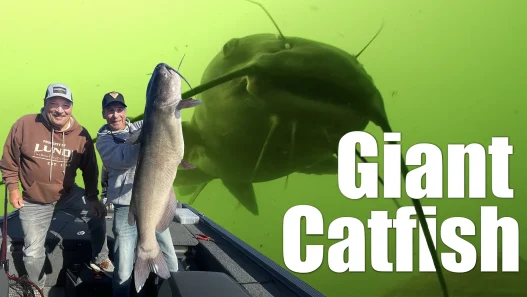






Jeremy Smith and Nick Lindner explore the Rainy River in early-fall for some hot big fish action, proving why sturgeon should be on every angler’s bucket list.
The Allure of Fresh-Water Giants
What counts as a “big” fish? For most anglers, the benchmark might be a 5- to 20-pounder. Yet even a modest Lake Sturgeon dwarfs those trophies—and often out-sizes big pike or muskies. If catching true behemoths is on your bucket list, you need look no further than Lake Sturgeon, a species enjoying a dramatic resurgence across the Upper Midwest.
Early each fall, Jeremy Smith and Nick Lindner head to northern Minnesota’s famed Rainy River to chase these living relics. Their mission: unlock prime locations, master slip-rig presentations in heavy current, and share straight-talk tactics for handling fish that can top 150 pounds.
High Water, Hard Choices—A Plan B That Pays
On this trip the duo planned to troll newly released Rapala Husky Jerk 14s for walleyes. Torrential rains, however, had the river running high, fast, and chocolate-brown—far from ideal walleye conditions. After scratching out a few eaters on jigs, they stowed the walleye gear, pulled out heavy rods, and pivoted to sturgeon.
“We’re loaded for bear,” Jeremy joked, brandishing the same soft-tipped stick he normally uses for small bucktails. An 8-foot musky or catfish rod with backbone and a forgiving tip is perfect for sturgeon, he explained—no need for hyper-specialized tackle.
Meet the Lake Sturgeon—A Prehistoric Powerhouse
Even a “small” Rainy River sturgeon astonishes. Its cartilage-based notochord lets the fish bend nearly in half, while armor-like scutes line its back until years of wear smooth them away. Oversized pectoral “wings” deliver explosive speed and stamina few freshwater species can match.
Handling tips from the boat:
- Grip the tail firmly and cradle the fish under the belly—never gill-hold.
- Beware the sharp scutes on smaller specimens.
- Keep fights short and fish in the water as much as possible for fast, healthy releases.
A Fishery Reborn: Clean Water & Smart Management
No agency champions Rainy-River sturgeon harder than the Minnesota DNR. Retired fisheries supervisor Tom Heinrich credits modern clean-water legislation for the species’ rebound. “There was enough of a remnant population that the sturgeon did it all by themselves,” he notes.
Key findings from ongoing tag-and-release studies:
| Metric | Males | Females | Notes |
|---|---|---|---|
| First spawning length | 50 in.+ | 50 in.+ | Length more critical than age |
| Spawning frequency | Every 2–3 yrs | Every 3–5 yrs | None observed <3 yrs |
| Common angler catch | 50–60 in. | — | 70-in.+ fish recorded at 120–150 lb |
Today, a visiting angler can reasonably expect multiple 50-inch fish in a day, with real chances at 70-inch monsters.
Tackle & Rigging Essentials
Terminal setup
- No-roll slip sinker: 1–4 oz; 2–3 oz covers most Rainy current.
- Leader or no leader: Jeremy prefers no leader to reduce tangles unless fish insist.
- Hook: 6/0 VMC 9299 Octopus—long shank, wide gap, stout wire.
- Bait: golf-ball-size gob of nightcrawlers sweetened with a fathead or shiner. Add glass beads, brass clackers, or small spinners ahead of the hook for flash and vibration.
Rod-reel-line
- 8’ medium-fast Mojo Cat or equivalent heavy bass/musky stick.
- Daiwa Lexa 300-size bait-caster.
- 50–65 lb Sufix Performance Braid in high-vis yellow for bite watching.
Casting technique
Lob, don’t whip. A slow side-arm toss keeps the bait ball intact. Let the rig settle, feel bottom, then set the rod in a holder with the bail open or drag just snug enough to prevent free-spool. A 100-pound sturgeon will make short work of a locked-down reel left unattended.
Tagging, Tracking, and the Angler’s Payoff
Every tagged sturgeon reported by anglers helps biologists pinpoint migration routes, seasonal hangouts, and harvest rates. The reward is a data-backed management plan that sustains the fishery—and ensures there will always be 100-pound dinosaurs waiting for the next adventurous angler.
A Night Bite Worth Waiting For
Jeremy’s rule of thumb: the closer to sunset, the hotter the action. Spend daylight hours chasing walleyes if conditions allow, but when the sky glows orange, soak fresh bait in the deepest river holes and brace for battle.
Their evening proved the point: after methodically working each hole, rod bows became routine. “This is what it’s all about,” Jeremy beamed, hoisting a thick, “average” Rainy River sturgeon—still over four feet long and powerful enough to humble seasoned musky gear.
Reading the River: Strategy, Positioning, and Persistence
Adapting to Wind and Current
When it comes to anchoring for sturgeon, the two biggest variables are current and wind, and they don’t always work in your favor. On this trip, wind blowing against current created one of the most difficult scenarios. Ideally, the crew would anchor the boat perpendicular to the current, allowing for a wide bait spread and full hole coverage. But with swift water and debris sweeping baits into tangles, they were forced to fish directly behind the boat, reducing their coverage zone.
To compensate, Jeremy employed a progressive casting strategy:
- Cast and let the bait soak for 3–5 minutes.
- Lift, reel in slightly, and re-cast 20–30 feet closer.
- After two or three “mini-moves,” reposition the boat 10–20 feet downriver.
This method keeps baits in front of fresh fish and significantly improves odds. As Jeremy put it, “20 feet that way, you’re creaming them. Right here, nothing.” A subtle move can make the difference between a slow day and a fish-filled frenzy.
Hooking Up in the Zone
Through strategic re-anchoring, the crew found a pocket of active fish. One after another, rods doubled over and drag peeled as the prehistoric beasts came calling. Even Nick, a first-time sturgeon angler, was blown away.
“It’s like catfishing on steroids,” he said. “We moved all around the hole—from the head, zig-zagged side to side, down into the deeper areas—and every second anchor spot we hooked up.”
The reward: consistent action, despite challenging conditions. Fish came on fresh rigs, often taking bait within minutes of casting. Some rolled and tangled, others fought clean, but all showcased why sturgeon are revered among serious anglers.
Pattern Recognition and Technology on Your Side
Side Imaging—A Game Changer
Locating sturgeon isn’t always about seeing fish directly. On traditional sonar or down imaging, they often blend into the bottom. But with side imaging, sturgeon become visible—especially over sand or when they’re slightly lifted off the bottom.
Jeremy explained their scanning strategy:
- Look for bottom transitions, small depressions, and structure breaks.
- Mark fish shadows using side imaging.
- Set up on the upslope or flat edge of a depression, where active fish often stage.
When fish are moving, they light up the graph. When they’re buried in cover or tight to bottom, visual confirmation gets tough, so anglers must trust the terrain and their instincts.
“I’ve got some really cool screenshots from over the years,” Jeremy said, “and they show just how clearly sturgeon can show up on this technology.”
Picking the Right Spot in the Hole
In one instance, the team found fish stacked on the tip of a deep hole, transitioning into shallower flats. These funnel points are prime when sturgeon are moving. But at this time, most of the activity was concentrated in deep, stable water, a common pattern during warm early fall conditions.
To stay on fish, the team used traditional anchor setups rather than spot-lock trolling motors, which would’ve drained batteries in the strong current. Sometimes the old-school way is still the most reliable.
Big Bites, Big Fights: The Power of the Prehistoric
When it comes to battling Lake Sturgeon, nothing in freshwater quite compares. Nick hooked into a tank and was instantly stunned by the raw power:
“It’s almost like I’m hooked up to a very, very large tree,” he joked, as line peeled and the rod loaded to its limit.
Jeremy coached from the sidelines:
- Keep the rod low to maintain leverage.
- Use short strokes to regain line.
- Stay calm and keep the pressure consistent.
“The harder you pull, the harder they pull back,” Jeremy explained. “If you want to play, they’ll play.”
A Whole Other Planet of Toughness
Sturgeon fight like no other. They run deep, change direction in an instant, and never quit. The crew compared them to catfish, even Goliath grouper, but ultimately agreed:
Sturgeon are in a league of their own—especially when the water is warm.
“You can whoop them a lot easier when the water’s 34 degrees,” Jeremy noted. “When it’s in the low 60s, they’ve got a lot more pull in them.”
As Nick coaxed his big fish boat-side, the team readied for the chaos of landing. He stepped forward, Jeremy tailed the beast, and together they brought another prehistoric river monster into the spotlight.
Short-Stroke Muscle: Landing Your Trophy
Big sturgeon seldom surrender without a marathon slog, but technique—not brute force—wins the tug-of-war. Jeremy’s boat-side coaching to Nick captures the essence: keep the rod low, use short, deliberate pumps, and maintain steady pressure. High, sweeping lifts waste leverage and fatigue anglers faster than fish.
With each controlled stroke Nick gained precious inches until the fish’s massive head finally surfaced. A quick lift, a careful tail grab, and the prehistoric giant lay across the gunwale—thick, armor-plated, and utterly spellbinding.
“If you’ve never experienced sturgeon, they’re one of freshwater’s most awesome fish—prehistoric beasts that pull like nothing else,” Jeremy said while Nick cradled his personal-best.
After a fast photo session, the crew revived the fish and watched it glide back into the Rainy’s tea-stained depths—stronger for the care taken during the fight and release.
A Hook with a Deeper Meaning
Back at the dock, Jeremy shared an encounter that put the day’s catches into perspective. After a faith-based fishing seminar earlier in the season, an elderly woman—quiet, petite, almost unnoticeable in the crowd—waited until every selfie and book signing was over. She pressed a tiny box into his hand and whispered:
“I’ve had this for 35 years, and God told me to give it to you tonight.”
Inside lay an antique fish-hook inscribed with Matthew 4:19: “Follow Me, and I will make you fishers of men.” Jeremy keeps the relic as a reminder that sharing knowledge—and goodwill—matters more than tallying trophies. The lady never told her full story, but her gift continues to shape his purpose on and off the water.
Final Thoughts & Season’s Sign-Off
From battling 100-pound river dinosaurs to reflecting on a simple verse, this Rainy River adventure underscores why we fish: challenge, discovery, stewardship, and connection. Clean water and sound management have resurrected a once-imperiled species; informed anglers now reap the reward.
Whether you’re plotting your first sturgeon trip or refining river tactics, remember:
- Stay mobile. Ten feet can separate empty hooks from bent rods.
- Read the electronics. Side imaging reveals giants hidden from traditional sonar.
- Handle with respect. Quick photos, firm tail holds, and gentle releases preserve tomorrow’s memories.
- Anchor your passion in something bigger. Sometimes a centuries-old hook carries more weight than a 150-pound fish.
From all of us here at The Edge, have a safe, fish-filled season. We’ll see you on the water—and online with plenty more tips, stories, and sturgeon-sized inspiration.

