





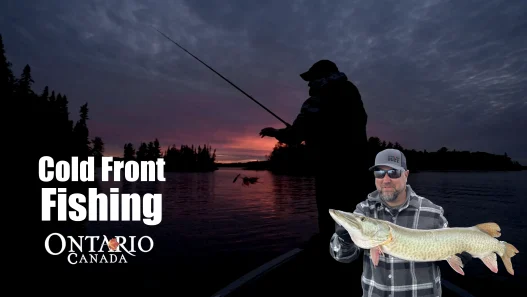




There are times in fishing when everything lines up perfectly—stable weather, predictable fish, and a clear plan. And then there are days like the one we experienced on Ontario’s legendary Wabigoon Chain, when a brutal cold front completely rewrites the playbook.
In just two and a half days, water temperatures dropped 12 degrees. Air temperatures went from nearly 80 degrees to a cold, rainy 47 with frost on the windshield the next morning. That kind of shock to the system doesn’t just affect anglers—it completely changes how fish behave.
And when that happens, the name of the game becomes adaptation.
A Multi-Species Playground in Sunset Country
We were fishing out of Bonney Bay Camp near Dryden, Ontario, owned by Len and Cynthia Huey. The camp sits on Wabigoon Lake, part of an incredible 11-lake chain covering more than 50,000 acres of fishable water.
It’s one of those places that defines what anglers love about Northwest Ontario.
You’ve got everything:
- Trophy walleyes
- Giant crappies
- Hard-fighting smallmouth bass
- Big northern pike
- Legendary muskies
- Perch, whitefish, and even sauger mixed in
You might show up targeting one species and end up catching five others. That’s the beauty of these big Canadian shield fisheries.
But when a major cold front blows through, even the best lakes can feel like someone flipped a switch.
When the Plan Falls Apart
Our original goal was simple: hunt muskies.
But after that temperature crash, the fish we expected to be active just weren’t where they should have been. Shallow water looked lifeless. Weed edges that normally hold muskies were empty.
So instead of forcing a pattern that clearly wasn’t working, we pivoted.
That’s one of the most important lessons in fishing—especially in Canada.
If the fish won’t cooperate with your plan, change the plan.
Instead of grinding all day for muskies, we started exploring:
- Looking for life on electronics
- Fishing deeper structure
- Targeting multi-species opportunities
And the results started to come together.
Finding Giant Crappies with Electronics
One of the first breakthroughs came while scanning with side imaging.
We located a sunken tree in about 16 feet of water. On the graph it didn’t look like much—just a dark shadow extending from the bottom. But that shadow told us everything we needed to know: structure.
After turning on forward-facing sonar, we saw what we hoped for.
A couple of fish holding tight to that tree.
We dropped a small minnow-style plastic down into the cover—and immediately hooked into one of the biggest crappies I’ve seen in a long time.
Wabigoon is famous for producing giant slabs, and that fish was a perfect example.
When conditions get tough, these isolated pieces of cover can become fish magnets.
The Power of the Plastic Minnow
When we’re traveling in Canada, one bait style almost always makes the trip.
A jig and plastic minnow.
It’s simple, versatile, and incredibly effective for multiple species.
During this trip we rotated between several styles:
- Paddle-tail minnows
- Straight-tail minnow plastics
- Scented soft plastics
- Durable TPE plastics that hold up through multiple fish
Paired with the right jighead, this setup caught:
- Crappies
- Perch
- Walleyes
- Smallmouth bass
- Sauger
When fish are scattered and conditions are unstable, a versatile bait that appeals to everything is a huge advantage.
Slow Down for Cold Front Bass and Walleyes
Another pattern that emerged during the cold front was slow presentations on the bottom.
Smallmouth bass especially were glued to structure.
Dragging a jig slowly across rocks and weed edges produced some beautiful brown bass—even though they were clearly adjusting to the sudden temperature drop.
Walleyes were doing something similar.
Instead of roaming aggressively, they were sitting tight to:
- Weed pockets
- Edge transitions
- Hard bottom near vegetation
A subtle jig presentation worked far better than aggressive techniques.
Sometimes the key to success is simply slowing down enough to let cold-water fish react.
Covering Water for Muskies
Of course, we still had muskies on the brain.
So once conditions stabilized a bit, we switched gears and began jerk trolling and casting large blades to cover water quickly.
Even during tough conditions, covering water can eventually intersect with an active fish.
And eventually, it happened.
Pete hooked into a muskie that absolutely crushed his bucktail—a hard-earned reward after days of grinding through brutal conditions.
Moments like that are why anglers chase muskies in the first place.
Proper Muskie Handling Matters
Whenever we do hook into muskies, one thing always takes priority:
Fish care.
These are low-density, trophy-class fish. Handling them properly ensures the fishery stays strong for the next angler.
A few important steps include:
- Keeping the fish in the water while unhooking
- Using proper nets and tools
- Minimizing time out of the water
- Taking a quick photo and releasing immediately
Treating muskies carefully is how these incredible fisheries stay productive for generations.
Why Canada Trips Are So Special
What makes trips like this so memorable isn’t just the fish.
It’s the experience.
You can explore massive water, discover new spots, chase multiple species, and adapt to constantly changing conditions.
Even during one of the toughest cold fronts of the season, we managed to catch:
- Crappies
- Perch
- Walleyes
- Sauger
- Smallmouth bass
- Northern pike
- Muskies
That’s the magic of a place like the Wabigoon Chain.
Persistence, adaptability, and a willingness to experiment can turn a tough trip into one you’ll never forget.
And sometimes the best fishing stories come from the days when everything went wrong… until it finally went right.
