










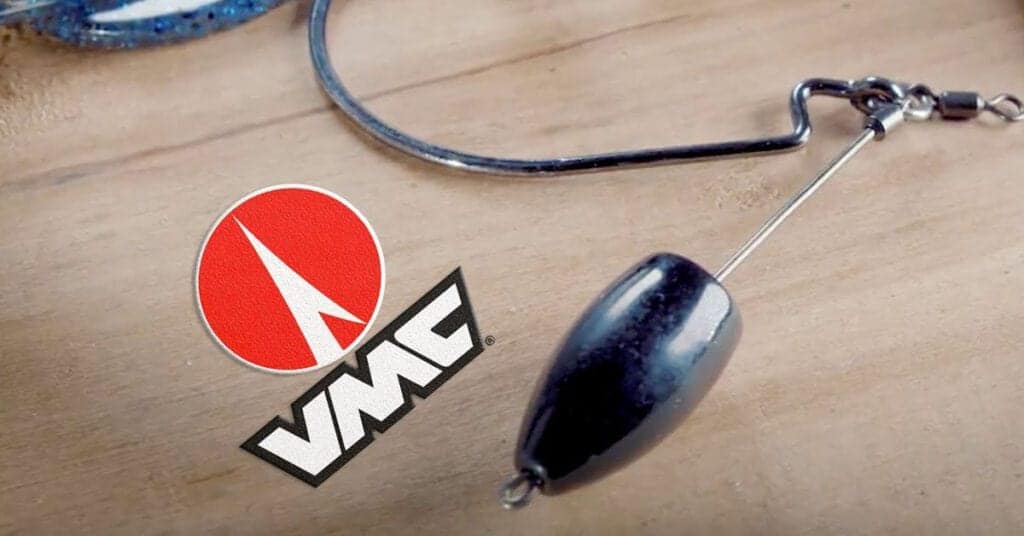
Bass fishing often is all about rigging: Texas Rig, Carolina Rig, Wacky Rig, Ned Rig, and more. But when I first saw VMC’s new “Tokyo Rig”, I admit to being somewhat dubious. I wasn’t sure how it would work, as it differed substantially from the rigs we regularly use for bass. But once I started fishing it and quickly became my go-to presentation in various situations. Its unique feature is that the weight hangs on a wire below the hook.
I found it a very effective summertime approach for fishing dense vegetation for the big largemouth bass that live there during the warm months. With the jointed Tokyo Rig, the sinker slips more easily through grass or slop than the heavy jigs or Texas Rigs with a big sinker we’ve used to punch through the canopy in the past.
It is not only easier and requires less weight, but it hooks bass better and reduces the number of lost fish. When a bass bites a big sinker or jig, it sometimes clamps its jaws on the weight, or else you may pop the fish’s mouth open on a hookset. With the sinker hanging below, there’s no such problem. The offset-shank, wide-gap that comes with it can hold all sorts of softbaits, so it’s versatile. Two favorites are a Craw Tube and a Big Bite Baits Fighting Frog.
This summer, I’ve started using a Tokyo Rig on deep rockpiles where largemouth and smallmouth bass feed in summer. It hangs up less than a football jig and again, it hooks fish better. Moreover, as you retrieve the rig, it clicks over the rocks, adding sound attraction to the package. And if there’s algae on the rocks, it catches on the weight, leaving the lure clean. In this situation, you can use swimbaits, craw-style lures, or big plastic worms.
Tungsten sinkers are dense so they transmit bottom type well. For rocks, I often use a pair of 3/8-weights rigged back-to-back, so they click as the rig bumps along. it is also works well on soft bottoms, as heavy sinkers can sink into silt, dragging your lure out of sight, while the Rig keeps it above bottom and visible to bass.
Tokyo Rig for Pressured Fish
The Rig can be effectively utilized to target pressured fish that have become accustomed to seeing the same fishing lures repeatedly. By harnessing the Rig’s adaptability and unique presentation capabilities, anglers can offer fishing lures in innovative ways that are likely unfamiliar to these fish. This approach can catch the attention of pressured fish and entice bites, as it introduces a fresh and novel presentation compared to the traditional methods they encounter regularly.
Recommended Setups for Rigs When setting up your Tokyo Rig, it’s important to consider the right combination of rods, reels, hooks, weights, and soft plastics to ensure a successful fishing experience. For most Rigging applications, a baitcaster paired with a medium-heavy casting rod is the ideal choice. This setup allows for efficient and precise casting, as well as handling more substantial catches. In terms of rods, a 7-foot medium-heavy rod with a fast action is recommended for general Rigging.
This type of rod offers a good balance of sensitivity and power, making it suitable for a variety of fishing scenarios. Brands like Daiwa and Ark offer quality casting rods that are responsive and durable, providing value for the price point. When it comes to reels, a casting reel that can handle heavier loads is essential, especially when using the Rig for punching. The Daiwa Tatula SV TWS Casting Reel is a top choice for its performance and reliability, making it a favorite among anglers.
For hooks and weights, VMC Rig Wide Gap and Heavy Duty Flipping Hooks are popular choices that offer durability and strength. Pair these hooks with VMC Tungsten Slider Weights for optimal performance. Soft plastics work well with the Rig presentation and can attract a wide range of fish species. Experiment with different soft plastics to find what works best for your fishing preferences and conditions.
Overall, choosing the right combination of rods, reels, hooks, weights, and soft plastics is crucial for maximizing your success when fishing with Rigs. By selecting quality equipment and components, you can enhance your fishing experience and increase your chances of landing that prized catch.
Rigging a Tokyo Rig properly involves a straightforward process. To start, Texas Rig your plastic bait or thread it directly onto the hook. It is essential to ensure that the weight is properly positioned on the Rig’s split ring before you begin threading the plastic onto the hook. This step is crucial to prevent any twisting or tangling of the wire within your tackle box, which can lead to difficulties during rigging.
When rigging the weight, you can opt for various types such as a barrel weight, egg weight, bullet weight, or bass casting weight. Slide your preferred weight onto the rig and then bend the wire’s end to secure everything in place. If you are using a heavier weight, it is advisable to create more than just a 90-degree L-bend in the wire to ensure proper stability.
By following these steps and being mindful of the weight positioning and wire alignment, you can effectively rig a Tokyo Rig with ease.
Like many innovative rigs that have come along in recent decades, this one is credited to inventive Japanese anglers who looked for a better way to catch bass in lakes where fishing pressure can be intense. Like the drop-shot rig and others, this one is a big winner!

How does the Tokyo Rig differ from a drop shot rig in terms of weight attachment?
The Tokyo Rig differs from a drop shot rig in that the weight in the Tokyo Rig is connected to the hook via a wire dropper, whereas in a drop shot rig, the weight is typically attached to the line as a separate leader.
What is the purpose of using a wire dropper in the Tokyo Rig?
The wire dropper in the Tokyo Rig serves to hold the weight below the hook at a specific distance, enhancing the rig’s presentation and performance.
What is the material that connects the weight to the hook in the Tokyo Rig?
The weight is connected to the hook in the Tokyo Rig via a wire dropper, providing a unique setup for the rig.
In which country was the Tokyo Rig originally developed?
The Tokyo Rig was originally developed in Japan as a finesse rig.
How is the weight positioned in relation to the hook in the Tokyo Rig?
In the Tokyo Rig, the weight is hung below the hook on a wire dropper, allowing it to be positioned at a distance below the hook.
How is the Tokyo Rig related to the Jika Rig and what are the differences between them?
The Tokyo Rig is an extension of the Jika Rig, where an EWG hook is used with a drop shot weight attached to the eye of the hook via a split ring. The main difference is that the Tokyo Rig positions the weight further below the hook.
What is the specific structure and components of the Tokyo Rig?
The Tokyo Rig consists of a hook with a wire dropper that holds the weight below the hook at a further distance.
What advantages does the Tokyo Rig offer for bed fishing?
Bed fishing with the Tokyo Rig is highly effective due to the weight holding the bait in place while creating enticing action near fish nests. This feature can help trigger strikes from territorial or protective fish guarding their spawning areas.
How effective is the Tokyo Rig when used as a swing head?
Using the Tokyo Rig as a swing head offers a better and cleaner presentation. The bait stays close to cover, maintaining contact, which can be advantageous in enticing fish that are positioned near structures or cover.
How does the Tokyo Rig perform when fishing swimbaits deep on the bottom?
When fishing swimbaits on the Tokyo Rig, it allows for good bottom contact while keeping the swimbait swimming freely without snagging. This setup provides a clean presentation and ensures that the swimbait stays in the strike zone effectively.
How does the Tokyo Rig excel in punching mats?
The Tokyo Rig excels in punching mats as it can go through cover cleaner compared to a Texas rig with a bullet weight. It pulls the rig down through matted grass straight and easy, making it highly effective for punching through heavy vegetation.
How can a Tokyo Rig be employed effectively with Texas rigged plastics offshore?
Tokyo Rig can be employed effectively with Texas rigged plastics offshore by presenting the lure in a way that attracts bass in offshore environments. This technique allows for versatility in targeting bass in various fishing situations.
In what scenarios can a Tokyo Rig be used for fishing swimbaits deep on the bottom and as a swing head?
A Tokyo Rig can be used for fishing swimbaits deep on the bottom when targeting bass that are feeding in deeper waters. Additionally, it can be used as a swing head, offering a unique presentation style that can be effective in certain fishing situations.
What are some advanced applications of a Tokyo Rig, such as punching mats and bed fishing?
Advanced applications of a Tokyo Rig include punching mats, which involves getting the rig through dense vegetation to reach big largemouth bass, and bed fishing, a technique used during the spawning season to target bass on their spawning beds.
How can a Tokyo Rig be utilized beyond just displaying a lure a few inches off the bottom?
The Tokyo Rig can be utilized beyond just displaying a lure a few inches off the bottom by employing techniques such as punching mats, bed fishing, fishing offshore with Texas rigged plastics, fishing deep swimbaits on the bottom, and using it as a swing head.
What are some effective techniques for using a Tokyo Rig in bass fishing?
Some effective techniques for using a Tokyo Rig in bass fishing include punching mats, bed fishing, fishing Texas rigged plastics offshore, fishing swimbaits deep on the bottom, and fishing it as a swing head.

