






There are a lot of great things about a fishing trip to Canada, but one of my favorites happens after the boat is tied up for the day.
You’ve got a nice batch of walleyes hanging on an old-school stringer, everybody’s hungry, and you know exactly what’s coming next.
Fresh walleye for dinner.
That’s pretty tough to beat.
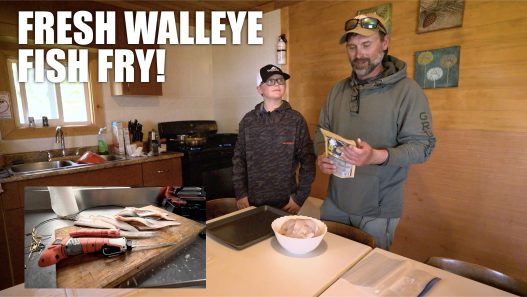
Crosby and I were on a little walleye mission up in Superior country, and we had some weather moving through. We’d already put together a nice catch of walleyes, so instead of trying to squeeze every possible minute out of the fishing day, we decided it was time to head back to the cabin and turn a few of those fish into a late-afternoon lunch-slash-dinner.
And, of course, we needed enough leftovers for boat food the next day.
That might be one of the most important parts of the whole operation.
An Old-School Walleye Stringer
I’ve got one of those old-school Rapala rope stringers that I ordered specifically for trips like this.
There are certainly more modern ways to keep fish, but there’s just something fun about coming back to the cabin with a stringer of walleyes. It’s practical, but it also brings back a lot of memories. Plus, if you’re filming or taking pictures, you can’t beat that classic shot of a nice bunch of walleyes hanging from a stringer.
These fish were destined for the table, and Crosby was pretty excited about the whole process.
Cleaning fish, cooking them and eating them together is part of fishing. Especially when you’ve got kids along, I think it’s fun to include them in the entire experience.
Catch the fish. Bring them in. Clean them. Cook them.
Then eat them.
It doesn’t get much more straightforward than that.
Cleaning Walleyes with the Bubba Electric Knife
For this trip I brought along the new Bubba lithium electric fillet knife, and it makes quick work of a pile of walleyes.
When I’ve got multiple fish to clean, I really like an electric knife for taking the sides off and removing the skin. It’s fast, efficient and lets you work through a batch of fish without making the process into a big production.
But I also brought another knife that I use all the time: the Bubba Folding Flex.
That knife stays in my boat.
Even though I really like the electric knife for the bigger cuts, I still prefer a traditional flexible fillet knife for some of the detail work—particularly removing ribs and working around the Y-bones.
That’s one thing I’ve learned over the years: you don’t necessarily need one knife to do everything.
Different tools are better for different cuts.
With the electric knife, I can quickly remove the sides of the fish and then come back through and take the skin off. Once I’ve got a clean fillet, I grab the Folding Flex and work underneath the ribs, running that flexible blade along the rib cage so the bones peel away while leaving as much meat as possible on the fillet.
It’s a simple system, and once you get into a rhythm, you can clean a nice batch of walleyes pretty quickly.
Keep the Little Guys for the Frying Pan
When I’m choosing walleyes for a fish fry, I really like those smaller fish.
They’re just perfect.
The smaller fillets cook evenly, they’re easy to handle, and you get those beautiful little crispy pieces that everybody seems to fight over.
We were also bringing some fish home, so we had a plan. The smaller walleyes were going into the frying pan that afternoon, while some of the bigger ones were getting saved for the trip home.
Crosby and I agreed that Betsy would probably appreciate that decision.
That’s another thing worth thinking about anytime you’re keeping fish on a trip. Don’t just start cleaning everything without considering what you’re eating immediately and what you’re transporting home. Know the regulations for where you’re fishing and how fish need to be packaged or identified during transportation.
Once that was figured out, it was time for the important part.
Let’s cook some walleyes.
The World’s Easiest Cabin Fish Fry
I’m a big believer that cooking fish at the cabin doesn’t need to be complicated.
You’re on a fishing trip.
Nobody wants to bring 27 ingredients, six mixing bowls and half the kitchen from home just to fry a few walleyes.
For this fish fry we used Papa Valachy’s Frytastic coating. We’d actually used it at a party recently alongside some other coatings, and people really seemed to gravitate toward this stuff.
It’s also incredibly simple.
Wet fillets.
Ziploc bag.
Fish coating.
Shake.
Fry.
That’s my kind of recipe.
The beauty of a simple dry coating like this is that you don’t need to make a batter or mess around with eggs, milk and a bunch of other ingredients. When you’re at a cabin or fishing camp, simple is good.
We had the potatoes nearly finished, the oil warming up and a hungry kid waiting for fish.
Time to get cooking.
The Crosby Shake-and-Bake System
This is where having a kid along really improves the cooking process.
I put a handful of fresh walleye fillets into the Ziploc bag with the fish coating and handed the operation over to Crosby.
That’s about it.
The key is not overstuffing the bag. We found that doing roughly four pieces at a time worked nicely. That gives the fillets enough room to move around so the coating can get onto every surface.
Give the bag a good shake until everything is evenly covered, pull the fillets out and shake off the excess.
When we opened the bag, those fillets looked perfect.
Nice even coating.
Nothing complicated.
Nothing fancy.
Just walleye ready for hot oil.
Into the Fryer
We were running our oil at about 250 degrees for this particular batch and cooking a few pieces at a time rather than filling the fryer.
That’s important.
Anytime you’re frying fish, don’t dump a mountain of cold fillets into the oil at once. Work in manageable batches. It makes the fish easier to handle and helps everything cook more evenly.
We dropped four coated pieces into the oil and let them fry.
Then you wait for that magical transformation.
Fresh white walleye fillets go in.
Golden, crispy deliciousness comes out.
You don’t need to overthink when they’re finished. You’re looking for good color on the outside and fish that’s cooked through and flakes apart easily.
When we pulled that first batch out, it looked awesome.
Hot.
And about as fresh as fish can possibly get.
These walleyes had literally been hanging on the stringer about a half-hour earlier.
People say “you can’t get any fresher than that” all the time.
Well, in this case, you really can’t.
Don’t Forget the Beans
Now we’ve got fried walleye and potatoes.
Are we finished?
Not according to Crosby.
He wanted beans.
Of course he wanted beans.
So we loaded up the plate with crispy walleye, potatoes and beans, and suddenly we’ve got ourselves the full North Country cabin meal.
Nothing fancy.
Nothing that would impress a five-star chef.
But after spending the day catching walleyes with your kid, I’m not sure there’s a meal at any restaurant I’d rather have.
That’s part of what makes these trips special.
More Than Just a Fish Fry
We spend a lot of time talking about fishing techniques.
Electronics. Boat control. Rods. Reels. Baits. Finding fish. Catching fish.
And I love all of that stuff.
But fishing is bigger than the moment when a fish hits the net.
Some of my favorite memories happen afterward.
It’s Crosby dragging in the stringer.
It’s standing at the cleaning table showing him how we turn a walleye into a fillet.
It’s handing him a bag of fish breading and telling him to shake it up.
It’s waiting around the fryer and sneaking that first crispy piece when it’s probably still a little too hot to eat.
And then it’s sitting down together with a plate full of fish that we caught ourselves.
That’s fishing.
The whole process.
And when you’ve got fresh walleyes, a good fillet knife, a simple fish coating and a hungry crew, you really don’t need much more than that.
Well…
Maybe a few extra pieces for boat food tomorrow.
Because cold fried walleye in the boat the next day?
That’s pretty darn good too.
I kept the cleaning and cooking details faithful to Jeremy’s transcript while building out the family/cabin-fishing atmosphere. Bubba Electric Knife Fish Clean…