








Exploring Sunset Country’s Muskie Waters: A Journey on the Winnipeg River System
First Strikes on New Water
There’s a unique thrill in exploring new muskie water, especially when the payoff comes early. Within minutes of casting, Jeff hooked into a beautiful muskie that made a boat-shy dash before turning back—an encouraging start to what would become a productive adventure. The moment marked more than just a catch—it affirmed the promise of the region’s legendary fishing.
Using electronics to dissect the underwater terrain, the anglers identified a classic spot: a big point extending from an island, descending into a pile of round boulders in 50 feet of water. As they suspected, it was prime muskie habitat—and it produced.
Welcome to Big North Lodge on Gunn Lake
This trip brought the crew to Big North Lodge and Outposts, nestled along the shoreline of Gunn Lake near Minaki, Ontario. The lodge sits on the iconic Winnipeg River System, which channels water north from Lake of the Woods to Lake Winnipeg. This area is renowned for its outstanding muskie fishing, with miles of productive shoreline, varied structure, and expansive back bays.
As Jeff and his crew explored the area, their excitement was evident. “Who doesn’t want to come to a place and run into a pile of these things?” one remarked after another solid hookup. Their appreciation for the landscape and its wildlife matched their love for the fishing—something every serious angler can relate to when fishing in Ontario’s Sunset Country.
Action Picks Up on Homemade Baits
Armed with homemade baits, Jeff got on the board early with a thick-bodied muskie—a textbook fish caught at the peak of the moon phase. “Right at moon,” Jeff noted, referencing a prime time in the muskie world. “12:14 right now, and moon major’s at 12:14.”
These fish weren’t just biting—they were hot. The team quickly dialed in a pattern of rock and weed transitions that held aggressive muskies. “Good-looking fish up here,” Jer added. “They’re thick.” Multiple fish followed, and more than one encounter ended in dramatic boatside strikes, showcasing why this part of Canada is truly muskie central.
Sampling the System and Developing a Pattern
Faced with challenging conditions, the team adapted by covering water quickly and sampling a wide range of structure—from Gunn Lake to Little Sand, Big Sand, and Rough Rock. Rather than hunker down on known spots, they marked potential high-percentage areas for return visits when conditions improved.
“We’re not getting married to any one spot,” they explained. “We’re just trying to find the combo—where we’ve seen bait, where we’ve seen fish, and especially where rock meets weeds.”
The fishery was full of massive boulders—some the size of small cars—and weed growth in the pockets between them proved especially productive. In fact, nearly every fish seen came from those rock-weed combos.
Hot Fish, Big Strikes, and Near Misses
A dramatic moment unfolded when a muskie crushed a jerkbait at the boat, only to throw the hook moments later. “Oh my cow, dude, that was awesome,” Jeff said, heart racing from the adrenaline of the boatside strike. Another came moments later—a fish lit up on a follow and struck hard.
As Jer battled the muskie to the net, the team worked in tandem to secure it. “That was cool,” Jer said. “Got her in the corner.” They even spotted a red tag on the fish’s back—possibly part of a local study. “South Dakota boy knows how to rope,” they joked. Despite losing a few bucktails in the chaos, spirits were high. “Muskies… they’re so awesome,” Jeff added. “That is so cool.”
Mapping and Electronics: Critical Tools
When asked what fishing technology is most important, the answer was clear: mapping. “It’s absolutely amazing,” Jeff said. “The spots just stick out.” With their shallow-water highlights set to 10 feet, they could quickly locate isolated structure. The team also made use of MegaLive for precise boat control and side imaging to assess boulder size and placement.
“Without the map, you couldn’t do any of it,” they emphasized. The system helped them identify fishy-looking zones and return with precision when conditions improved.
Rods, Reels, and Line: The Ideal Setup
Years of muskie fishing and filming have led the team to refine their gear preferences. Jeff now relies on an 8’6″ St. Croix rod—medium-heavy power with a fast action—paired with a Daiwa Lexa 300 reel. “It’s like having a wand in my hand,” he said. “It’s been a real blessing for me.”
His partner was using a Legend Elite Muskie rod, St. Croix’s top-tier model. Both anglers spooled with Sufix ProMix braid, noting its excellent shock strength—an important feature when casting big baits and dealing with the inevitable fatigue and occasional backlash.
The Tools, Tactics, and Faith Behind a Successful Muskie Adventure
Line Strength That Holds Up
One of the keys to confidence in muskie fishing is trusting your gear—especially your line. For the crew on this trip, Sufix Pro-Mix braid was the unanimous choice. On bucktail rods, they used 65-pound test, while setups throwing big rubber or jerkbaits were bumped up to 80. The result? Years without a lost bait. That level of performance, particularly under the stress of aggressive fish and heavy hardware, speaks volumes about the line’s shock strength.
The Thrill of the Chase
The action didn’t slow. Whether it was a fish trailing close, teasing just out of strike range, or bursting into acrobatic leaps on hookup, every encounter added to the excitement. “He didn’t know which way to go, so he went up,” Jeff laughed after one muskie exploded skyward. The thrill of interacting with these apex predators—win or lose—remained unmatched. “So fun,” Jer added. “They are hands down, in my opinion, the coolest fish in freshwater.”
Battling the Wind with Power and Precision
Despite wild, hat-stealing winds, the anglers remained effective thanks to their powerful trolling setup. The Minn Kota Ulterra 112 provided the muscle to hold position, even in the face of heavy gusts, while Dakota Lithium 100Ah batteries ensured all-day runtime, even pushing 15+ hours. “You never run out of power,” they emphasized—a must-have combo for muskie anglers who fish hard and long in remote Canadian water.
Built for Battle: Smart Boat Rigging
Beyond the trolling motor, the boat itself was dialed in for multispecies flexibility. Thanks to Lund’s SportTrak System, they mounted rod holders, cameras, and nets for quick access and smooth transitions between presentations. Whether targeting muskies, walleyes, crappies, or pike, this versatile setup handled it all with ease—especially important in unpredictable weather and mixed-bag fisheries.
Don’t Lose the Hot Bait: Bucktail Repair on the Fly
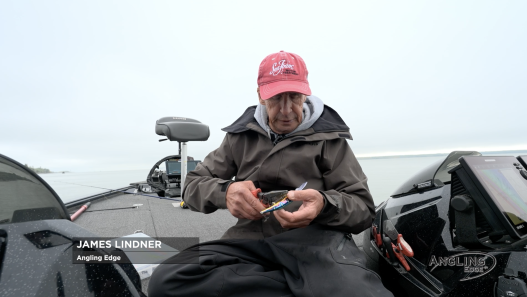
When a bucktail got destroyed in the mouth of an aggressive muskie, Jeff pulled out a bucktail repair kit—a simple but invaluable tool. With spare wire, hooks, and pre-rigged components, he was able to rebuild the bait in minutes and get back in the game. “What could be the end of your day… now you’re fishing again. Bucktail back in business.”
One Final Strike to Cap the Trip
As the trip drew to a close, Jer connected with a perfect fish—after a string of teases and turn-aways. “That one was cooperative,” he grinned. The battle was classic muskie: visual, tense, and exhilarating. “We earned that one,” Jeff added. The experience, like the fish, was richly rewarding.
Scenic Backdrops and Trophy Potential
From encounters with black bears to the abundance of thick, healthy muskies, the trip had everything. The average size was remarkable, the strikes electric, and the setting unforgettable. “I mean, this is just what we’re seeing,” Jer explained. “Not a bunch of 36s and 38s. We’re talking real fish.”
Big North Lodge and the waters surrounding Gunn Lake delivered the kind of memorable fishing and wild country that draw anglers back, season after season. “Who doesn’t want to come to a place like this?”

