








When you’re trolling for lake trout in really deep water, catching fish is only one piece of the puzzle. To me, a big part of the fun is figuring out the entire system.
Your downriggers matter. Your rods and reels matter. Your lure selection and trolling speed matter. But one of the most important components of the whole program is your electronics.
When you’re dealing with lake trout suspended well over 100 feet down, you aren’t simply trolling around hoping to run into one. You’re using your electronics to identify the productive depth, understand what’s happening below the surface, and then put your baits right where those fish are living.
Once all those pieces come together, deep-water lake trout trolling can become an incredibly efficient—and really enjoyable—way to fish.
Electronics Are the Heart of the System
On this particular boat, I’m running two Humminbird XPLORE 10s, which gives me the ability to dedicate different screens to different jobs.
One of those units is heavily focused on mapping.
That’s especially important when you’re fishing a huge body of water where subtle changes in depth, structure and underwater contours can dictate where those lake trout are going to be.
I’m also using a Humminbird AutoChart Zero Line Map Card, which allows us to really dial in the depths we’re looking for.
Instead of looking at the lake as one massive piece of water, we’re trying to narrow everything down.
Where is the productive depth?
Where are the fish?
What’s the thermocline doing?
Where does the structure intersect with that productive water?
Once you start answering those questions, an intimidating amount of water suddenly becomes much more manageable.
Understanding the Thermocline
On this trip, one of the biggest factors affecting the lake trout was the thermocline.
We’re fishing during the fall, so these trout are beginning to transition toward their spawning areas. Under normal circumstances, you’d expect that seasonal movement to start pushing more fish toward shallower water.
But there was a catch.
The thermocline was still extremely deep and hadn’t broken down yet.
That meant the fish weren’t necessarily where you’d expect them to be based strictly on the calendar.
Instead, they were compressed into a specific depth range.
That’s an important lesson with lake trout—or really any species. Don’t fish where you think the fish should be. Fish where your electronics tell you they actually are.
In our case, the magic number was right around 169 feet.
And when you looked at the sonar, there wasn’t much guessing involved.
That’s where the fish were.
Mapping Gets You There—Sonar Confirms It
This is where having multiple electronics becomes incredibly useful.
On one screen, I can concentrate on the mapping and boat positioning. On the other, I can watch what’s happening underneath us.
When we’re marking trout consistently around that 169-foot zone, now we’ve got something we can work with.
The next step is getting our presentations into that exact portion of the water column.
That’s where the downriggers come into play.
Deep-water trolling isn’t just about dropping a cannonball down until the counter reads a certain number. You have to consider your trolling speed, direction, current, lure action and how all of those variables interact.
It’s truly a system.
Trolling Speed Changes Everything
Speed is another piece of information I’m constantly watching on the electronics.
When we’re trolling spoons for lake trout, I want those baits running correctly. Too slow and they might not have the action we’re looking for. Too fast and you can completely change how the lure behaves.
But there’s another variable that’s easy to overlook:
Current.
On a big lake, underwater current can have a major influence on your effective trolling speed.
You might have the boat traveling at what appears to be the perfect speed, but your spoon could be behaving very differently depending on whether you’re trolling into the current, across it or with it.
That’s why we don’t simply pick a number and forget about it.
We’ll watch the speed, check the action of our spoons, make adjustments and determine which direction produces the presentation we’re looking for.
Once we establish the productive trolling direction and speed, we can start repeating it.
And repeatability is everything.
Dialing In the Downriggers
Once we’ve identified the fish on the electronics and figured out our trolling speed, it’s time to dial in the downriggers.
This is where deep-water lake trout fishing becomes really interesting.
We know approximately where the trout are positioned. Now our job is to put those spoons directly into their feeding window.
If we’re seeing fish concentrated around a particular depth, we can adjust each downrigger to cover that zone. Depending on what we’re seeing, we may stagger presentations slightly above and below the primary depth until the fish tell us exactly what they want.
That’s another reason good sonar is so important.
We’re not fishing blind.
We’re watching the fish, watching the depth and continually refining our presentation.
When one rod starts producing more consistently, that’s information.
Maybe it’s a particular spoon.
Maybe it’s running slightly higher.
Maybe the boat was traveling a little faster on that pass.
Maybe the current changed.
Every bite gives you another clue.
The Fun Is Figuring Out the Puzzle
That’s really what I enjoy about this style of fishing.
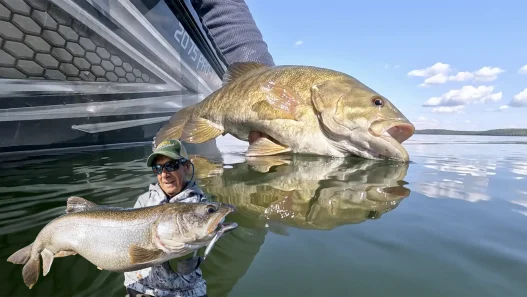
Sure, catching a giant lake trout is the ultimate payoff. There’s nothing quite like seeing one of those rods load up and watching somebody battle a big trout from deep water.
But catching the fish is almost the finale.
The real fun is figuring everything out.
You start with a giant lake.
Then you use your mapping to narrow down the area.
Your sonar tells you where the trout are positioned.
The thermocline helps explain why they’re there.
Your electronics tell you the speed.
The downriggers put the baits at the correct depth.
Then you start experimenting with trolling direction, lure action and presentation until everything begins clicking.
When you finally get the system dialed in and rods start firing, there’s a real sense of satisfaction because you didn’t just stumble into those fish.
You figured them out.
A Great Way to Fish With Your Buddies
There’s also a teamwork aspect to downrigger fishing that makes it a great way to spend a day on the water with friends.
On this trip, we’ve got one guy working the back of the boat, keeping an eye on the rods and downriggers, while I’m driving and concentrating on the electronics, speed and trolling path.
Everybody has a job.
Then somebody yells that a rod is going, and the whole boat instantly shifts into fish-catching mode.
That’s exactly what happened as we were talking about the system.
Suddenly—
Fish on.
And it was a good one.
At that point, somebody grabs the rod, I stay on the wheel and keep the boat positioned correctly, and it’s game time.
That’s lake trout trolling.
Build a System You Can Repeat
If you’re interested in trolling deep-water lake trout, don’t think of the downrigger as a standalone piece of equipment.
Think about the entire system.
Your electronics help you locate the fish and understand their environment. Mapping helps you follow productive contours and structure. Sonar shows you exactly where trout are positioned in the water column. Your speed reading helps you duplicate productive passes. Your downriggers put the presentation into the strike zone, while the right rods, reels and spoons finish the job.
When everything works together, you’re no longer randomly trolling across a giant lake.
You’re targeting a very specific group of fish in a very specific portion of the water column.
And that’s what makes modern lake trout fishing so much fun.
Find the fish. Identify the depth. Dial in the speed. Set the downriggers. Repeat the productive pass.
Then when that rod loads up, grab it and hang on.
Because after you’ve spent all that time solving the puzzle, a big lake trout on the other end is a pretty darn good finale.

